Motorized windows: what a glass wall actually needs
A motorized window is the one part of a facade where the product, the machine and the fire strategy meet in a single opening. The window is rated as a window. The drive is a separate appliance with its own safety standard. Where the opening also vents smoke, a third certificate covers the assembly. Most of the problems on site come from treating those three as one purchase.
Short answer
Specify the window to the fenestration standard of the market, the drive to EN 60335-2-103:2023+A11:2023, and add EN 12101-2 only where the fire strategy uses the opening as a smoke vent. The window standard does not assess the ability to open, so nobody in the chain certifies egress unless the project names who does. State the leaf size and weight, the stroke, the force limit, the control interface and the sensor priority on the drawing.
A motorized window is three products in one opening
The glass and frame are rated by the fenestration standard, which asks about air, water, wind and thermal performance and nothing about what moves the sash. The drive is rated as an electrical appliance, and its standard is written around the injury a moving sash can do to a hand. Where the same opening is part of the smoke strategy, the assembly is certified again as a ventilator.
That split is not paperwork for its own sake. Each certificate names a different party as responsible, and each one fails in a different way. A unit can be watertight to its class, hold a valid drive certificate, and still be non-compliant on site because the closing edge was hung 1.4 m above the floor with no protection system.
What the window standard covers, and what it leaves out
EN 14351-1:2006+A2:2016 applies to manually or power operated windows, so a motorized unit is inside the window standard and is CE marked under it like any other window. The same scope carries a line that matters more than it reads: the windows covered by this standard are not assessed regarding their ability to release.
North America separates the two more bluntly. AAMA/WDMA/CSA 101/I.S.2/A440:22, known as NAFS, rates windows and doors, and its scope excludes motorized operators outright. The drive is outside the document that rates the window, so a NAFS label says nothing about the motor, the controls or the closing force.
The drive has its own standard, and it is written around hands
EN 60335-2-103:2023+A11:2023 covers electric drives for gates, doors and windows. Its scope is explicit about where the responsibility lands: hazards from moving doors and gates are covered together with EN 12453 or EN 16005, and the hazards from the movement of a window are covered by this document alone. Roof windows are named among the drives in scope.
Annex BB is the window annex, and it is where a specification gets its numbers: the closing force envelope, the obstacle test, the rule against unexpected closing, the behaviour on a wiring fault, and the escape route for a trapped hand.
Actuator types against what they will move
| Type | Force range | Stroke and opening | Where it fits |
|---|---|---|---|
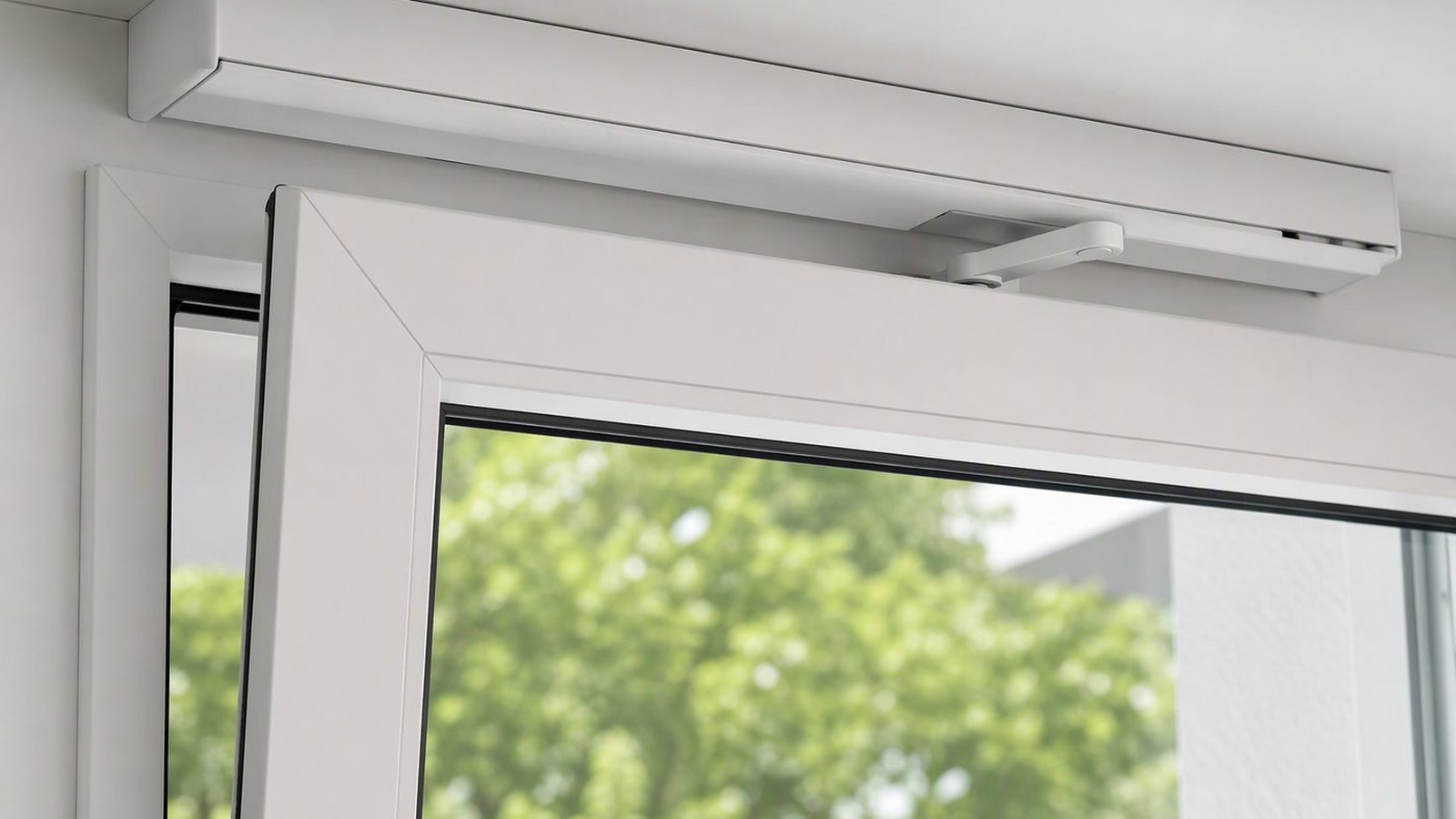
| Chain | Up to roughly 300 N | Short to medium stroke, modest angle on a tall leaf | Daily ventilation on standard casements and roof windows |
| Spindle | Higher than chain at short travel | Short stroke, straight push | Small vents, top-hung sashes, roof access hatches |
| Articulated arm | 300 N, 500 N, 750 N | Reaches 90 degrees, leaves up to about 1,800 by 1,800 mm | Smoke ventilation, large sashes, special shapes |
| Synchronised pair or bank | Shared across two or more drives | Long stroke on a wide vent, movement kept parallel | Large roof vents and banded glazing |
The force envelope, measured on an 80 mm plate
The closing force is not a single number, it is a curve with a time axis. BB.20.107.2 allows 150 N during the first five seconds after the force passes 25 N, and 25 N from that point on. The alternative envelope allows a 400 N peak for the first 0.75 s after the force passes 150 N, then 150 N for a further 4.25 s, then 25 N.
The measurement is defined as tightly as the limit. The instrument carries a rigid plate of 80 mm diameter and a spring of 500 N/mm, and the amplifier has to rise and fall within 5 ms, so the peak is caught, not averaged away. The drive is run at the least favourable voltage between 0.94 and 1.06 times rated, with the force set to its highest user-adjustable value.
That clause catches projects. A drive commissioned at a low force setting passes on the day it is set up; the test assumes the worst setting a user can select, which is why the force setting belongs in the handover document.
The obstacle test, and the speed that replaces it
BB.20.107.1 places a block of roughly 25 by 100 by 300 mm in the path of the leading edge, at any position and in the least favourable orientation, and closes the window onto it. The sash has to stop, or move only in the opening direction. For a horizontal sliding leaf the block is tried with a reflective face and a matte black one in turn, because a light curtain sees one and misses the other.
There is a second route to compliance that costs performance instead of hardware. Where the drive is operated by a switch that has to be held, the closing speed is capped at 15 mm/s, which is slow enough for a hand to be withdrawn. Above that speed the drive needs a protection system, and the protection system has to keep working through a fault: BB.20.109 requires the sash to stop within one operating cycle if the sensor wiring is shorted or opened.
No unexpected closing, and the creep test
A vertically moving window that closes on its own is a different hazard from a sash that closes onto a hand, and BB.20.108 treats it separately. The drive is left unpowered at the least favourable voltage and loaded with 1.2 times its rated load for 30 minutes. Nothing may move beyond the initial taking up of play, and any creep is limited to 1 mm/s.
For a top-hung leaf on a tall facade, that test is why a gas strut appears on the drawing: the drive holds the leaf with the power on, and the standard asks what holds it with the power off.
Manual release, and the order after a power cut
Every drive needs a manual release or a reversible mechanism, with an operating force no higher than 220 N or 1.6 Nm. The figure is not generous by accident: it is the force a person can apply by hand, without a tool, in the dark, on a mechanism that may not have moved for a year.
Two rules sit behind the release. The operator must not start unexpectedly when power returns, and after an interruption the drive must not restart on its own outside an automatic mode. With several openings on one controller, the first movement after a power cut should be a deliberate command, not a controller waking up and closing everything at once.
Smoke duty turns the assembly into a different product
Where the fire strategy uses the opening to clear smoke, the requirement is EN 12101-2, and it applies to the assembly, not to the parts. The window, the actuator and the fixings are tested as one unit, and the declaration of performance states the characteristics the fire engineer designs around: the aerodynamic free area, the reliability count, operation under load, low-temperature operation and heat exposure.
The aerodynamic free area is always smaller than the physical opening, because the frame, the sash geometry and the actuator all reduce what smoke can actually pass. It is the number used in vent sizing, never the aperture dimension on the architect drawing. Reliability is expressed in cycles, typically 1,000 for a life-safety vent and 10,000 where the same opening also ventilates every day.
The performance figures are the ones that decide whether a standard drive can be used at all. The ventilator has to reach full stroke within 60 seconds of the alarm signal and keep working through 30 minutes at 300 °C. A drive selected for quiet daily ventilation is not automatically the drive that survives that, and the fire engineer is entitled to ask for the certificate, not the datasheet.
Chain, spindle or arm: what each one can actually move
The actuator is chosen by three numbers that have nothing to do with the window catalogue: the force needed at the leading edge, the stroke that produces the opening angle, and the leaf mass the hinge can carry. A chain drive is compact and quiet and runs out of force and stroke early. A spindle drive carries more force over a shorter travel. An articulated arm reaches the 90 degree opening that smoke ventilation usually asks for, at forces up to 750 N and leaf sizes around 1,800 by 1,800 mm.
The arithmetic that gets missed is the geometry. A chain drive moves the sash by its stroke, so 750 mm on a 1.5 m leaf produces a modest angle, while 90 degrees on the same leaf needs more than 2 m of stroke and a force the chain cannot deliver. Where the leaf is large, two or more synchronized actuators share the load.
Sensors, and the order of authority
A motorized window usually carries more than one reason to move, and the reasons conflict: rain wants it closed, wind wants it closed harder, a CO2 or temperature signal wants it open, and a fire alarm wants it open regardless of the weather. The controller has to hold that hierarchy explicitly, and it has to be written on the drawing, not discovered during commissioning.
The absolute rule is that the fire signal outranks every comfort input. A rain sensor that closes the vent during a fire event is not a small commissioning error; it defeats the reason the ventilator exists. The second rule is that manual operation has to remain available above the automatic layer, for the fire service and for the person standing at the opening.
Where the drive lives, and why it fails
On a motorized window the actuator sits in the least forgiving place in the assembly: a narrow cavity between the frame and the wall, on the cold side in a heating climate and the hot side under a roof, with condensation running down the profile. The enclosure rating is the first line of defence, and the second is drainage, because a drive that stands in water fails whether or not its IP number was correct on the bench.
The failures that reach a service desk are predictable: a chain full of grit from a dusty site, a battery that ends the opening function quietly in year five. Each is easier to prevent at the drawing stage than to fix from a cradle.
What to send the factory
The order for a motorized window is only as good as the opening data behind it. The list below is what avoids a second round, and every line of it can be answered from the schedule and the elevation.
- The leaf size, the leaf mass and the hinge side, per opening.
- The opening angle or clear opening required, and whether the duty is ventilation or smoke.
- The actuator type wanted, or the force and stroke the geometry needs.
- The closing force limit the site can accept, and whether a protection system is fitted.
- The control interface: dry contact, bus, or a building management protocol.
- The sensor set, with the priority order written out.
- The power supply, the battery hold-up required, and where the controller sits.
- The standards the unit and the drive have to be certified to, by market.
The last line is the one that gets answered with a brochure. It is a window plus a machine plus, sometimes, a life-safety device, and each of the three has a document behind it. Asking for all three with the quotation is cheaper than finding out at handover which one was never issued.
Frequently Asked Questions
Does a motorized window need a different window standard?
No. The window is rated as a window under EN 14351-1:2006+A2:2016, which covers power operated units, and under NAFS in North America. The drive is rated separately to EN 60335-2-103:2023+A11:2023, and NAFS excludes motorized operators from its scope altogether.
Can a motorized window serve as the escape route?
Only if the project names who certifies that function. EN 14351-1 states that the windows it covers are not assessed regarding their ability to release, so the egress duty sits outside the window label and has to be attached to a route that is checked on site.
What closing force is allowed?
Annex BB of EN 60335-2-103:2023+A11:2023 allows 150 N for the first five seconds after the force passes 25 N and 25 N after that, or a 400 N peak for 0.75 s followed by 150 N for 4.25 s and then 25 N. It is measured on an 80 mm plate with a 500 N/mm spring.
Can any casement be motorized?
The hinge will take a drive, but the geometry may not. The stroke needed for the opening angle grows with the leaf height, and the force grows with the leaf mass and the wind load on it. A tall leaf that looks like a chain drive on the drawing often needs two synchronized actuators.
When is a smoke certificate needed?
When the fire strategy uses the opening to clear smoke. The assembly is then certified to EN 12101-2 as a complete unit, and the declaration states the aerodynamic free area, the cycle count and the heat exposure class the engineer is designing against.
What happens when the power fails?
The drive has a manual release or reversible mechanism with an operating force of 220 N or 1.6 Nm at most, and it must not restart unexpectedly when power returns. Where the opening has to move during an outage, the battery hold-up is sized at the order stage.
Which market standard covers the motor?
The drive standard, and it is separate from the fenestration standard in every market. EN 60335-2-103:2023+A11:2023 is the European reference, referenced alongside EN 12453 and EN 16005 for doors and on its own for windows.